Ona’s Narfa Identity and Stigma
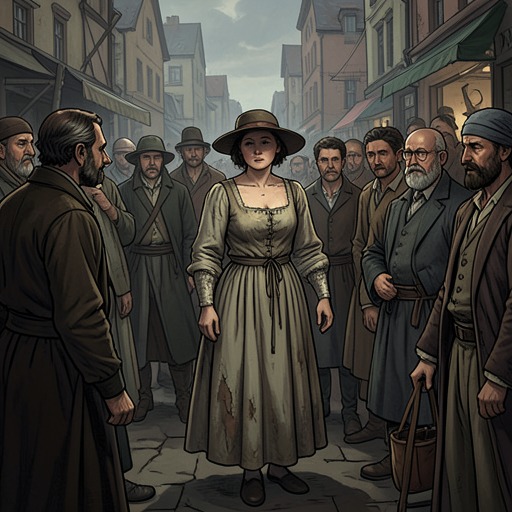
Women TalkingOna Friesen’s Narfa identity makes her a target of judgment in Molotschna Colony, where her pregnancy, unmarried status, and reputation for eccentricity are treated as evidence against her. The label is used to question her capacity to reason, but the narrative steadily reverses that verdict: Ona’s attention to facts and her presence among the women become sources of insight, and the narrator imagines her as a lasting guide for the children of the colony.
Identity and Origins
The colony’s account of Ona’s Narfa status reaches back to her father Kurt’s death. The elders and colonists describe her condition as latent before he died and say that afterward she gave herself to dreamy eccentricity. The circumstances of Kurt’s death remain disputed: Peters says Kurt died after seeing the devil while shooting crows, while Agata’s account, supported by Ona but not wholly by Salome or Agata’s grown sons, is that Kurt died by suicide. The narrative records these competing accounts without making the community’s supernatural explanation authoritative.
Ona’s eccentricity is paired with an unusual commitment to facts. Rather than presenting that interest as proof of disorder, the narrator treats it as part of her distinctive presence and observes that Ona seems to prefer her position as a pariah, even as the colony casts her as the devil’s daughter and a burden imposed by God. The narrator’s counter-description is markedly different: Ona is a light, unobtrusive presence, not the danger her stigma implies.
Pregnancy, Judgment, and Exclusion
During the women’s meetings, Ona keeps an empty feed pail beside her because pregnancy makes her nauseated. When her pregnancy becomes apparent, several colony women hurry to arrange a marriage between her and Julius Penner, the simple son of Ondrej Penner. Ona refuses the proposed match on the grounds that Julius deserves better and that marrying her would expose him to sin because she is not a virgin. Her reasoning is set against the elders’ judgment that Narfa has made her incapable of reasoning, a charge the narrator identifies as deeply ironic.
The stigma has practical consequences beyond the attempted marriage. The elders plan for Ona’s unborn child, conceived through the assaults in the colony, to be raised by another family, perhaps even the family of one of the attackers. Her pregnancy is thus treated not only as a reason to judge her but also as a circumstance in which the community claims authority over her child. Later, Klaas will not look at Ona or acknowledge what she says; because of her Narfa, unmarried status, and pregnancy, he treats her as less than a person. The narrator notes that being treated as a ghost seems to suit Ona, a comment that suggests her distance from the colony’s judgment without claiming that it removes the harm of exclusion.
Voice and the Women’s Decision
Ona is not merely the object of other people’s accounts. She participates in the women’s deliberations, asks questions, and listens closely to the narrator’s response about whether adolescent boys can pose a threat. When the narrator recalls the educational principles of his mother, Ona looks up and silently mouths the words about sympathy and love alongside him. The moment places her within a shared exchange of thought and care, in sharp contrast to the elders’ portrayal of her as incapable of reason.
Her presence also belongs to the women’s collective effort to decide how to protect themselves and their children. Agata argues that leaving can uphold pacifism, love, and forgiveness more faithfully than remaining in a situation that risks further violence. She presents the decision to protect the women and children as both an act of maternal instinct and a considered commitment to faith. Within this debate, Ona’s stigmatized position does not reduce her to a passive emblem: she is one of the women whose participation helps make their deliberation possible.
Reversal and Narrative Legacy
The narrator’s final imagined portrait gives Ona a future beyond the community’s labels. He pictures himself teaching boys about her and writing her name at the top of every lesson guide. In that imagined schoolhouse, she becomes a point of orientation for students across Mennonite colonies: the person who began as the devil’s daughter and became, in the narrator’s vision, God’s most precious child and the soul of Molotschna.
That transformation is not a reported change in the colony’s treatment of Ona; it is the narrator’s hoped-for counter-memory. The ending makes the struggle over her identity a struggle over who gets to tell the story. Against a culture that can turn restricted knowledge into rumor and stigma, Ona’s love of facts becomes a form of inheritance. The narrator imagines her remembered not for the label imposed on her, but for her curiosity, her laugh, and the direction her example might give to those who come after.